ADVERTISEMENT
- Real Recipes from Real People -
READ REPLIES
Kelsey McCloskey-Huckin
For a school assignment (year 8) I have to find a traditional Aboriginal recipe, and make/cook it. Can you assist?
Many thanks
Gladys/PR
(in Spanish) or natives were vegetarians & they ate roots. Nevertheless, here are some typical recipes, but with an English flavor to them. I recommend that you do the Search in the Internet & at least read the names of the roots they ate. Probably some of those roots are like our yuca, which taste like the potatoes or our ñame. It is important for your general information & culture that you read that material. Here are a couple of the recipes found at Aussie Foodies: Typical Australian Food:


LAMINGTONS

It is said that Lamingtons were invented in the Queensland Government House kitchen as a creative use for stale sponge cake. I do not recommend that you use stale cake, but the mixture is easier to handle if the cake is not too fresh and crumbly. They are named after Lady Lamington, the wife of the Governor of Queensland from 1896 to 1901.

2 cups self-raising flour
pinch salt
3/4 cup sugar
125 gm butter
3 eggs
a few drops of vanilla essence
1/2 cup milk

Sift the flour and salt together. Cream the sugar and butter, and add the eggs and vanilla essence. Beat well, then fold in the flour and salt mixture and add the milk.
Grease a tray about 50cm deep and add the mixture. Bake at 180ºC for 30-35 minutes and allow to cool on a wire rack. When it is cold, cut the cake into 3 inch squares.

ICING FOR THE LAMINGTONS:
2 cups of icing sugar.
4 tablespoons of cocoa.
125gm butter.
1 teaspoon of lemon essence.
warm water.
2 cups of desiccated coconut.

Start to make the chocolate icing by sifting the icing sugar and cocoa together. Melt the butter, add the lemon essence and beat into the sugar and cocoa mixture. Beat well and add enough water to give the required consistency - sticky and gooey, so that it will stick to the cake and not run off.

Put the coconut into a shallow tray. Dip each lamington in the icing and then roll in the desiccated coconut while the icing is till moist. Leave to dry on a wire rack. Messy to make but wonderful to eat!


MEAT PIE

This is one of Australia's "icon" dishes. It is traditionally about 15cm (6 inches) in diameter and eaten in the hands with tomato sauce (or tomato ketchup, is you are from the U.S.A.) and is usually accompanied by a cold beer.

The pastry is always shortcrust, with sometimes a flaky pastry cover. This recipe makes one large pie or several smaller ones. The smaller ones, just large enough to hold in one hand, are the most common in Australia, being sold as snack food.

1 1/2 to 2 kg chuck steak, trimmed and chopped into small cubes. 3 bacon rashers (optional), chopped
2 onions, peeled and chopped
2 cups water
1/2 teaspoon black pepper
1/2 to 1 teaspoon salt
1/2 teaspoon dried thyme (optional)
1 stick celery, finely chopped (optional)
3 tablespoons plain flour
1 batch shortcrust pastry (see below)

Fry the bacon and onion over a low heat until the onion is soft. Add the chopped steak. Pour in the water and season with the salt, pepper, and thyme. Then add the celery. Cover and simmer for about 1 1/2 hours.

Mix the flour with a little water to a smooth, runny mixture (roux), then stir this into the meat mixture. Stir until the mixture thickens. Pour into a deep pie dish. If you are making small pies, then line small pie dishes with the pastry and fill them with the meat mixture.

Wet the rim of the pie with milk or beaten egg. Place a layer of pastry on top of the pie to form a lid. Trim the lid to the shape and size of the pie dish. Press the edges together with a fork to seal. Make some steam holes in the top and glaze with beaten egg or milk.

Bake in a hot oven for 30-40 minutes (maybe less for the smaller ones).

SHORTCRUST PASTRY:
3/4 cup plain flour
3/4 cup self raising flour
pinch salt
100 gm cooking margarine or butter
3 tablespoons cold water
1 teaspoon lemon juice

The above ingredients make one batch of the shortcrust pastry for the meat pies. You might need to make more than one batch to complete the small pies.

Place the flours and salt into a mixing bowl, rub in the margarine or butter with your fingertips, and mix into a dough with the water and lemon juice. Turn out onto a lightly-floured surface and knead lightly with a little flour. Let it rest for about 20 minutes before rolling it out into a sheet ready for the pie crust.
Gladys/PR
They are known as Bush Tucker Recipes or recipes using Australian bushfood plants. Those plants were the ones used by the natives. Here are some recipes for your selection:

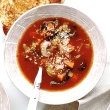
TOM YUM BUSH (AUSTRALIAN THAI-STYLE CORN AND LIME SOUP)

1 litre water
1 large onion, sliced
1 medium carrot, diagonal slices
1 medium zucchini, diagonal slices
corn kernels from 2 cobs
8 Chinese or shittake mushrooms, sliced
1 teaspoon coriander seeds
250g packet of Oz lemon fettuccine
2 tablespoons soy sauce
2 tablespoons Thai fish sauce
1 tablespoon mirin
1 teaspoon ground Oz lemon
4 small Wild limes or 2 large limes finely sliced

Bring the water to a boil and add the onion and carrot slices. Simmer for 5 minutes. Add the remaining vegetables and the coriander seeds and cook a further 5 minutes. Add the fettuccine, cover and simmer for 8 to 10 minutes until the pasta and the carrots are done. Finish with the remaining seasonings, adding the lemon myrtle and wild limes and removing the pot from the heat. Leave stand for a few minutes to allow the flavours to infuse and serve, allowing one small lime per serve. This soup can also be served chilled as a summer soup.


WHOLE BABY BARRAMUNDI AND MUNTHARI BUTTER SAUCE

400g whole baby barramundi
30ml vegetable oil
2 drops gumleaf oil (careful, this product is very strong)
1 tbspn butter
30g finely chopped leak
1/2 cup munthari berries
pinch of lemon myrtle
seasonings.

Combine the vegetable oil and gumleaf oil and heat in a frypan to smoking temp. Pan fry fillets until skin is crispy (about 2 mins). Turn over and cook the other side (1 min. or less). Set aside in a warm dish. In the fry pan, melt butter, add leak, muntharies and seasonings. Plate up fish, garnish with leak and muntharies and finish with a generous sprinkle of ground lemon myrtle.


WILD FRUIT COMPOTE

100g Illawarra plums
50g small wild limes
100g munthari
50g wild rosella
1 tablespoon lemon aspen juice
2 tablespoons honey
icing sugar for dusting

Coarsely chop the Illawarra plums and toss them in the lemon aspen juice. Place the limes and rosella into separate bowls and add sufficient honey-sweetened water to cover them. Leave them soak for 15 minutes. Drain. Combine the prepared fruits with the munthari and serve, finished with a sprinkle of icing sugar.


SYDNEY SALAD

400g mesclun lettuce mix
50ml light lemon myrtle mayonnaise
1 avocado, sliced
4 red cherry and 4 yellow pear tomatoes
100g emu prosciutto
15ml akudjura
50g shaved parmesan
75g Alpine pepper croutons
whitlof leaves for garnish
1 small carrot

Prepare the 4 Opera House garnishes by selecting 4 x 5 whitlof leaves of decreasing size. Make a hole at the base of the leaves with a paring knife and pass a spear cut from the carrot through the hole to make the 4 forward pointing sails and one small reversed sail of the Opera House. Store in iced water until required, if necessary. Arrange four serves of salad in the middle of appropriate plates. Garnish with the avocado slices, quartered tomatoes and smoked quail egg halves. (See following note). Drizzle the salads with the mayonnaise, add the emu prosciutto, akudjura and parmesan. Set the Opera House garnish in place using extra lettuce leaves to secure them and finish the salad with the croutons. Serve at once.

Note: To smoke hard-boiled, shelled eggs simply place them on a rack in a covered wok containing bunya nut shells with some sawdust (optional) and heat the shells to smoking. Eggs will take from 2 to 14 hours to smoke depending upon how much smoke is generated and the size of the eggs.


NATIVE PEPPERBERRY POTATO CAKE

6 native pepperberries (count the double berries as one)
5g lemon myrtle
60g melted butter
4 large potatoes, peeled, boiled but firm and very thinly sliced
60g parmesan, flaked

Squash the native pepperberries into the melted butter and add the lemon myrtle. On an oiled tray, arrange 4 piles of potato slices brushing each layer with the flavoured butter. Finish the top with the parmesan and bake at 180ºC for 15 minutes and if desired, further grill the top to brown.

There is plenty of background information in the Internet. Good Luck with your assignment.

Gladys/PR
Ann,Queensland
Hi Kelsey

By reading this you will understand there are no 'traditional' recipes as such or that I know of.

Most people go hunting on the sea and some go hunting in the bush. People on the sea go hunting for turtles, fish, crabs, dugong and go into the mangroves for mudshells, oysters and crabs. In the bush you can find bush fruit and more food like goanna, pigs, wallabies and more. But the most hunted food is most of the sea food like the dugongs and turtles.

The most common cooking methods are roasting on the coals, cooking in the ashes, steaming in a ground oven and boiling.

ROASTING ON HOT COALS

This is a technique for cooking meat and fish. Foods roasted on the open coals of a fire include most meats, fish and small turtles. Meat is usually cooked in this way when it has to be eaten immediately, though most bushmen would accept that it is better cooked in a ground oven.

The catch is generally first thrown on to the flames of a fast burning fire. After about ten minutes it is taken off the fire, and cleaned. It is then returned to the fire, which has subsided to form a bed of hot coals. Turtles, snakes, goannas and fish are also cooked this way and are quickly cooked through.

When combined with slow cooking in the coals, the roasting method produces very juicy cooked meats, which have a hard skin. The flesh of the game stays chewy - considered by Aboriginals as gourmet and a as a reason for their excellent teeth.

BAKING IN THE ASHES

All types of dampers, seeds, nuts and root vegetables are cooked in the hot ashes. It is important to select good wood for this cooking fire; many Australian native bushes have slightly irritant properties and some ashes are never used by Aborigines for cooking. Acacias are safe and fast burning. Some foods such as witchetty grubs are simply rolled in the hot ashes; some such as damper and goanna are placed on the hot ground beneath the ash and covered with more hot ash.